People sometimes ask how we came up with the name Cats Cradle Robbers.
When I was a kid, we used to play this game with string that you may be familiar with. Cats cradle involves forming a figure with a loop of string between your two hands. Your partner then takes the string in a specific way and forms a new figure through the act of taking the string. This is a creative back and forth cooperative process; a game of digital capoeira if you will. Really good players can make up new figures as they go.
The Robber in Cats Cradle is the person who takes the string away and turns it into something new and surprising. I don't know if this is a common term, or just something we made up - I haven't been able to find any reference to it online. I like to think DJSE and I play a sort of Cats Cradle game with music as we pass it back and forth, taking turns being the Robber and adding something new and surprising with each pass. So, we're the Cats Cradle Robbers.
You're welcome.
-Snake
Friday, March 26, 2010


Sunday, February 7, 2010
Tone Poems
A lot of the time we start out a session with no agenda – Essey lays down some beats, or I start some riff or other. The mood of the piece evolves as we add more sounds. Sometimes, the music starts to suggest a story or an idea, and we follow the suggestion. Other times, we start with a specific idea in mind. This week, we spent a Saturday afternoon working on a Bhangra-inspired construction whose working title was “One Thousand Lawyers” (more about how we come up with track names in a future post).
Bhangra is a form of music from the Punjab region of India. Its origins are in folk dancing, but the infectious rhythms and the unique sounds of the folk instruments have spawned a whole genre of Indian house music. I wanted to see if we could replicate that sound and add our own stamp to the format, pulling in a funky bass line, and atypical instruments such as the Afro-Brazilian berimbau and our usual assortment of found-object percussion.
My typical attitude towards vocals in music is to treat them as musical elements, not as lyrical elements. The actual words, if there are words at all, are often an afterthought. But as we evolved the Bhangra construction, it seemed to call for a vocal, and so we started scribbling down lyric ideas, starting with a melody and a rhythm, and trying to fit vowel sounds to the shape of the music. What we came up with evoked the idea of stumbling home in a monsoon rain through chaotic streets after a night of clubbing in Mumbai. Here are the words, starting at 2:52, to what we’re currently calling “Acid-Washed Dreams”:
Here are a few other examples of constructions that started with no specific idea and evolved into stories:
The Possum and the Pea
Whimsical woodland creatures go about their oddly anthropomorphic business with a happy demeanor. In the evening, they go to a rave.
Nice Driveway
A down and out Slavic musician belts out a traditional Russian folk tune on the street outside a seedy bar after too much vodka.
Corruptional facility
Students are routinely brainwashed at a school staffed by jack-booted fascists (I imagine this is the same school we met in Pink Floyd’s “another brick in the wall”).
First Frost in the Garden
Adam tosses and turns through the longest night in Eden, his head filled with disturbing dreams, while Eve is off on a sinister and unprecedented errand.
That's all for today, cradle critters. Enjoy!
-Snake
Bhangra is a form of music from the Punjab region of India. Its origins are in folk dancing, but the infectious rhythms and the unique sounds of the folk instruments have spawned a whole genre of Indian house music. I wanted to see if we could replicate that sound and add our own stamp to the format, pulling in a funky bass line, and atypical instruments such as the Afro-Brazilian berimbau and our usual assortment of found-object percussion.
My typical attitude towards vocals in music is to treat them as musical elements, not as lyrical elements. The actual words, if there are words at all, are often an afterthought. But as we evolved the Bhangra construction, it seemed to call for a vocal, and so we started scribbling down lyric ideas, starting with a melody and a rhythm, and trying to fit vowel sounds to the shape of the music. What we came up with evoked the idea of stumbling home in a monsoon rain through chaotic streets after a night of clubbing in Mumbai. Here are the words, starting at 2:52, to what we’re currently calling “Acid-Washed Dreams”:
It’s not raining, it’s steaming
Virgins blaspheming Shiva
And in weaving these visions
To believe is to leave her
Cars and bars and whores
Among the the Bollywood nights
The lights and the stars making the boulevard soar
Until they lock the doors and it’s just me, alone
Walk in the warm rain
Steam rising from the street in the heat
To be alive in the city of flowers and songs and mycelium dreams
Here are a few other examples of constructions that started with no specific idea and evolved into stories:
The Possum and the Pea
Whimsical woodland creatures go about their oddly anthropomorphic business with a happy demeanor. In the evening, they go to a rave.
Nice Driveway
A down and out Slavic musician belts out a traditional Russian folk tune on the street outside a seedy bar after too much vodka.
Corruptional facility
Students are routinely brainwashed at a school staffed by jack-booted fascists (I imagine this is the same school we met in Pink Floyd’s “another brick in the wall”).
First Frost in the Garden
Adam tosses and turns through the longest night in Eden, his head filled with disturbing dreams, while Eve is off on a sinister and unprecedented errand.
That's all for today, cradle critters. Enjoy!
-Snake
Sunday, December 6, 2009
Hot off the press - the new Weftovers video by Snake!
DJ Essey and I have been hard at work constructing new audio works - check out the media page at http://catscradlerobbers.com to see what's new (I'm particularly partial to Dewy Iris, and our latest track "1000 Lawyers" is a Bhangra-inspired sketch that should grow into something really interesting in time).
I work a bit slower in the video department, but I've finally completed the music video for Weftovers. This started with footage shot during the initial session with Tomo Hoku at Ed's place, and I took off from there, using this project as a testbed for a number of advanced digital compositing and animation techniques I've been learning in my spare time.
So, for example, I augmented the original footage with shots of myself practicing Capoeira, my daughter and I on the trampoline, and a number of shots taken against the orange and green walls of my living room and front hallway. On the evening that Ed arrived at my place to create "Fall's Scents", he walked into an improvised green screen studio where I coerced him into lip-syncing his own poem in order to build the facial morphs for the poem sequence in the video.
Enough chatter - on to the video. Enjoy, and please post feedback!
- Snake
I work a bit slower in the video department, but I've finally completed the music video for Weftovers. This started with footage shot during the initial session with Tomo Hoku at Ed's place, and I took off from there, using this project as a testbed for a number of advanced digital compositing and animation techniques I've been learning in my spare time.
So, for example, I augmented the original footage with shots of myself practicing Capoeira, my daughter and I on the trampoline, and a number of shots taken against the orange and green walls of my living room and front hallway. On the evening that Ed arrived at my place to create "Fall's Scents", he walked into an improvised green screen studio where I coerced him into lip-syncing his own poem in order to build the facial morphs for the poem sequence in the video.
Enough chatter - on to the video. Enjoy, and please post feedback!
- Snake
Sunday, October 25, 2009
CCR goes international with a feature in Prairie Magazine
Our good friend Tomoko Hoku Hellman writes an occasional piece for the Japanese-language Prairie Magazine. We were delighted when she wanted to do a piece on the band. For those of you who can follow along in Japanese, the article is online here:
http://www.sumutoko.com/chicago/prairie-backnumber/hoku/2009/0910/0910.htm
For those who prefer English, here is a rough translation:
http://www.sumutoko.com/chicago/prairie-backnumber/hoku/2009/0910/0910.htm
For those who prefer English, here is a rough translation:
Construction of Sound
I have been very interested in checking out “Private Label Musicians” in the area. Nowadays, you can pretty much get any kind of music at CD stores or on the internet, and iTunes is a great tool. But, I was ready to get something more, something like “musical endeavor” in my ears.
I found that music – Cats Cradle Robbers.
Guitar and drums… sure, you can hear them in CCR’s music. But you will also hear unusual and undiscovered instruments. “Let’s find sounds from this room today (Boiling the Ocean)”, “How about, we feature Polynesian instruments for this song? (Weftovers)” The concept for the music is created between Nick and Ed, who are also elite computer techies in their daily jobs. I was lucky enough to observe their “Saturday Morning Session” at Ed’s apartment – or Cats’ Cradle.
Nick and Ed call it “Construction” – to describe their music session.
Construction starts at Ed’s apartment. Laptop, digital audio workstation, microphones, headsets… hmm… looks like some kind of office recording studio. Next to his table, there were the ingredients for today; guitar, flute, ukulele, uliuli, iliili (rocks)… Nick, who has 30 years of music experience, starts to create music by using these instruments – amazingly, he can make a great sound with any of these so quickly. Ed, the DJ, picks up every single sound that Nick creates, without losing Nick’s passion and the instruments’ unique vibes. Mix them, delete them, add them… there was a pleasant amount of mystery as well as confidence as he worked. The whole process of construction was led passionately, yet casually. These Robbers totally robbed my attention.
Their vision for CCR is very positive and it contains unlimited possibilities of what could happen in the future. “We are helping to create a unique musical vocabulary for the 21st century by embracing and recombining multiple musical styles in a playful and genuine way. I also would like to figure out a way to bring CCR to a live audience (Nick).” “ and, have as much fun as possible! I want to keep learning more about music (Ed)”
Hoku: “Where did you get a name “Cats Cradle Robbers?”
Nick: “Cats Cradle is from child’s play. Cradle Robber is a term that has a rakish, taboo connotation with a subtext of envy. I like to play with words. It’s also an advantage that if you enter it into Google, our website is the first hit in the search results.
Hoku: “At the session, it looked like Nick is the dominant person to decide speed, instruments, and basic structure of the music – is it always that way?”
Ed; “Not really – every session is different. But Nick has to do the talking, as I have the recording tools.
Nick: “With my experiences and knowledge, I try to enforce rhythmic patterns, intonation, an so forth, while trying to give Ed enough freedom that he can express himself while mixing the sounds.
Hoku: “Any disagreement during sessions?”
Ed: “ Nope – We are not really hung up on the end product. We just like to play and have fun.”
Nick: “It does not hurt that we are both practitioners of Yoga and Eastern philosophy, which help us lay egos aside and focus on what’s important. Of course, I am sure we will have to deal with disagreements eventually, though.
Hoku: “It seems like your construction pattern was about ‘adding ingredients’ and then mixing them together. Have you ever done ‘taking away ingredients?”
Nick: “ We almost always record more samples than we use in the final tune. Later we rearrange them so that they are more separate, or take all apart and remove some of them. Case by case, really. ‘Kickin’ in Rio' is a great example.
Ed: “Somehow, though, our best stuff often happens in one take, and the pieces that we construct and reconstruct over several sessions don’t seem to have the same kid of magic.”
Hoku: “How many hours does it take to finish one song?”
Ed: “two hours… or one month and yet not done… it all depends…”
Hoku: “Tell me about guest musicians.”
Nick: “Anyone who happens to be around gets pulled into a session; gifted jazz pianist Steven Markowitz of Polyrhythmics, multiinstrumental environmentalist Joe Breskin, and the wonderfully creative Sumit Basu. Sumit joined for ‘Jack In the Bucket’ and ‘Toasting More Often’.”
Hoku: “Where can we enjoy your music?”
Nick and Ed: “Visit http/catscradlerobbers.com, please!”
Sunday, August 9, 2009
Weftovers: Notes by DJSE
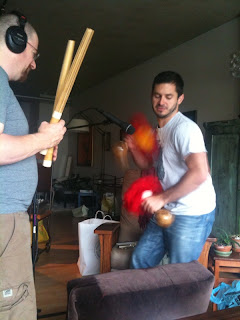
Yesterday morning I woke up with a churning stomach. I felt like Christmas poo. But we were getting together to jam, and the show must go on. Somehow Snake and I got to the new place in music that we had been talking about approaching. finally a song-like structure with key-changes throughout the piece. And this is probably the first danceable piece that we've put together. All of this marked the beginning of a new "album" on our site.
Early in the session, we were joined by mutual friend Tomo, who brought over a bag of farm fresh fruits, a number of Hawaiian instruments, a loaner flute, and the camera that took the stills from this session. We already had a couple of loaned ukuleles from my friend Vinny, and that along with Tomo's uli uli, ili ili and pu ili, helped us bring a Hawaiian flavor to our construction.
The session started with me asking for a speed and Snake calling out 99.30bpm, then I started messing with a drum build at that speed. Snake jammed on the uke and layered in a tropical rhythm section. We started dancing with the percussive Hawaiian instruments and added them to the intro build. The ili ili was a really fun one to play given it's vibrant plumage. Then I added in a high synth melody contrapuntal to Snake's uke rhythm.
Meanwhile, Tomo was jotting notes and recording stuff for a future magazine article that she may include us in. She seemed pretty surprised by our process. We just pick some starting parameters, then get to playing. It's always a bit different, but having some stuff looping all the time with the mic in the middle of the room gives an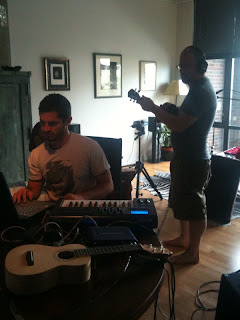 opportunity for all kinds of fun stuff to work it's way in. Who knows what yours truly will decide to record and add into the mix while Snake is running around making sounds?
Then we reached the key point, we added in B and C sections to the track. Different chords, different rhythm sections, different instrumentalism and driving percussion. As we continued to work and fill these sections in, we brought in harmonica, threw a wah-wah effect over Nick's acoustic Dobro guitar, ...
Surprise for me: Snake can play the flute. Fun stuff.
The reading by Snake is the early draft of a poem that I wrote in Port Townsend. I condensed the poem into my personal blog's first haiku Weft and Warp. The name of the piece came from this reference, with a little joke about how Homestar Runner might pronounce it.
At the end of a seven hour session, we ended up with a tune in a pretty listenable place. Give Weftovers a try. Happy listening!
 opportunity for all kinds of fun stuff to work it's way in. Who knows what yours truly will decide to record and add into the mix while Snake is running around making sounds?
Then we reached the key point, we added in B and C sections to the track. Different chords, different rhythm sections, different instrumentalism and driving percussion. As we continued to work and fill these sections in, we brought in harmonica, threw a wah-wah effect over Nick's acoustic Dobro guitar, ...
Surprise for me: Snake can play the flute. Fun stuff.
The reading by Snake is the early draft of a poem that I wrote in Port Townsend. I condensed the poem into my personal blog's first haiku Weft and Warp. The name of the piece came from this reference, with a little joke about how Homestar Runner might pronounce it.
At the end of a seven hour session, we ended up with a tune in a pretty listenable place. Give Weftovers a try. Happy listening!
Here's a little peek of what the track looks like under the hood in Ableton Live 8:

Sunday, July 12, 2009
Truesetto: Reflections by Snake on a Saturday morning’s production.
DJSE embraces technology as the central figure in his musical world, and I admire and respect his passion in this area. My own inclination is to avoid electronic technology because of the continual need to improve, upgrade, and replace components, the learning curve, and the cajoling and fiddling needed to keep it all working, all of which I see as an impediment to the creative process. For me, there is no greater joy than to grab a random acoustic instrument and just play, exploring my relationship with another musician through sound.
It’s a pleasure to work with somebody who has the patience to wade through that morass and use that technology to add value to what I can produce. In the end, it can wind up being more than the sum of its parts. DJSE brings creativity and persistence, as well as a complementary viewpoint which adds the necessary tension to the creative process.
What I can bring to the table is more than 30 years of experience creating music on a variety of instruments, many of which I invented and built myself. This week’s early Saturday session featured two such instruments.
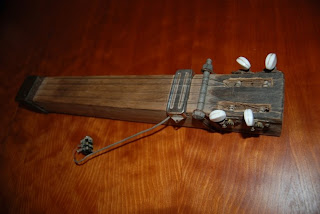
The Electric Dih is something that I invented while still in high school, and the construction of the only exemplar is typical of my function-before-form approach to most things. The Dih is about a foot long, created from a table leg, with 4 steel strings: one bass string, and four identical treble strings which are tuned in unison. The instrument is played by picking or strumming while using the tuning pegs to change the pitch of the uppermost string. The effect is unique, though I reflected today that the Dih may in fact be the closest thing to a physical manifestation of a spiitaarno (the conceptual merging of a piano and a sitar as represented electronically on Car Horns of the Spiitaarno).
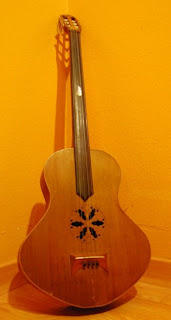
The Lindsay guitar is a one-of-a-kind instrument which was a collaboration between myself and luthier John Lindsay of Port Townsend. Created in the mid 1980s, it is essentially a fretless tenor guitar: 4 strings, tuned CGDA like a cello, with a curved fretboard and the scale length of that instrument, but plucked fingerstyle like a guitar. It is an exceptionally quiet instrument, and as such it is difficult to use in a live environment (my one live performance on the instrument was a 1991 duet with fellow guitarist Michael Townsend, which can be heard here). The Lindsay guitar is the bass instrument I played on Arabian Drive, one of the tracks on my 1988 album Introspection.
Today’s effort, with the working title of Truesetto, blends these instruments with electronic drums, bookmarked guitar (my Gibson L6 electric with a paper bookmark laced between the strings at the bridge to produce a muted, marimba-like sound), and trombone accents. We started by recording a raga-like rubato intro on the Lindsay guitar. We gave motion to the rest of the track with an energetic drum loop under two melodic phrases on the Lindsay, played as A and B sections. The bookmarked guitar doubles the B section. The Dih gives extra reinforcement to the B section while also providing an anchoring drone together with the trombone and the bass strings of the Lindsay.
We hope to polish up this tune and release a draft on the website in the next few weeks. Until then gentle readers, Namaste and enjoy your week!
It’s a pleasure to work with somebody who has the patience to wade through that morass and use that technology to add value to what I can produce. In the end, it can wind up being more than the sum of its parts. DJSE brings creativity and persistence, as well as a complementary viewpoint which adds the necessary tension to the creative process.
What I can bring to the table is more than 30 years of experience creating music on a variety of instruments, many of which I invented and built myself. This week’s early Saturday session featured two such instruments.

The Electric Dih is something that I invented while still in high school, and the construction of the only exemplar is typical of my function-before-form approach to most things. The Dih is about a foot long, created from a table leg, with 4 steel strings: one bass string, and four identical treble strings which are tuned in unison. The instrument is played by picking or strumming while using the tuning pegs to change the pitch of the uppermost string. The effect is unique, though I reflected today that the Dih may in fact be the closest thing to a physical manifestation of a spiitaarno (the conceptual merging of a piano and a sitar as represented electronically on Car Horns of the Spiitaarno).

The Lindsay guitar is a one-of-a-kind instrument which was a collaboration between myself and luthier John Lindsay of Port Townsend. Created in the mid 1980s, it is essentially a fretless tenor guitar: 4 strings, tuned CGDA like a cello, with a curved fretboard and the scale length of that instrument, but plucked fingerstyle like a guitar. It is an exceptionally quiet instrument, and as such it is difficult to use in a live environment (my one live performance on the instrument was a 1991 duet with fellow guitarist Michael Townsend, which can be heard here). The Lindsay guitar is the bass instrument I played on Arabian Drive, one of the tracks on my 1988 album Introspection.
Today’s effort, with the working title of Truesetto, blends these instruments with electronic drums, bookmarked guitar (my Gibson L6 electric with a paper bookmark laced between the strings at the bridge to produce a muted, marimba-like sound), and trombone accents. We started by recording a raga-like rubato intro on the Lindsay guitar. We gave motion to the rest of the track with an energetic drum loop under two melodic phrases on the Lindsay, played as A and B sections. The bookmarked guitar doubles the B section. The Dih gives extra reinforcement to the B section while also providing an anchoring drone together with the trombone and the bass strings of the Lindsay.
We recorded the Lindsay guitar with a single condenser mic oriented to record from my POV (this is my favorite mic position for recording, as it produces the most accurate reflection of what I hear when I play). The Dih was recorded direct-in. The bookmarked guitar was played clean through my Roland jazz chorus amp, with me sitting on the amp and the mic positioned halfway between the speakers and the bridge of the guitar to capture both the amplified signal and the buzz of the strings against the paper.
We hope to polish up this tune and release a draft on the website in the next few weeks. Until then gentle readers, Namaste and enjoy your week!
Sunday, July 5, 2009
Sharing the Creative Process
 To us, the best part about creating the music is the creation process itself. Each piece that we construct comes from a lot of play. We love hearing and reading about the creative processes of others, and this blog is an opportunity for us to share how we come up with our music, which we fondly refer to as "constructions". Each construction goes down a different path. Some are straight-forward and we finish one in a night, some meander for months. It's all fun and adds to the uniqueness of the creation.
At the end of the star-belly machine, we often get a construction that we love. Bonus!
Subscribe to:
Posts (Atom)